-
Recent Posts
- National Show 2024
- BBC Gardeners’ World
- Aston Clinton Show
- SEEDS Show 14 April 2024
- Ewhurst Spring Show
- RHS Daffodil Show, Wisley 9-10 April 2024
- National Show – 20-21 April 2024
- What is eating my flowers?
- Waingroves Show, Derbyshire
- Cornwall Garden Society show
- RHS Hyde Hall 20-21 March 2024
- RHS Early Daffodil Competition
- Name that Daffodil
- Register a New Daffodil
- 2024 Members’ Bulb Lottery
Recent Comments
- Editor on Society Information
- John Gurvan on Society Information
- Editor on RHS Daffodil Show, Wisley 9-10 April 2024
- Jeremy Wilkes on RHS Daffodil Show, Wisley 9-10 April 2024
- Editor on Society Information
- S trask on Society Information
- Editor on 2024 Members’ Bulb Lottery
- Michael Baxter on Name that Daffodil
- Editor on AGM 2024
- Richard Gillings on AGM 2024
Categories
- ADS
- Books and Publications
- Commercial cultivation
- Competitions & Lottery
- Coughton Court
- Daffodil Hunting
- Enquiries
- Events
- Garden Daffodils
- Historic Daffodils
- Medical Uses
- Miscellaneous
- News
- People
- Potted daffodils
- RHS
- Science
- Show Dates
- Show Results
- Shows
- Society Information
- Spain
- Virtual Show
- Virtual Show 2021
- Wild Daffodils
Archives
Classification System
What do those numbers and letters mean?
What are all those number and letter combinations that appear in daffodil catalogues? The Daffodil Society follows the Royal Horticulture Society’s (RHS) daffodil classification system. In 1975, the RHS adopted a colour code system devised by American Dr. Tom Throckmorton.
The letter refers to the colours of the daffodil as follows:
- W – White or Whitish
- G – Green
- Y – Yellow
- P – Pink
- O – Orange
- R – Red
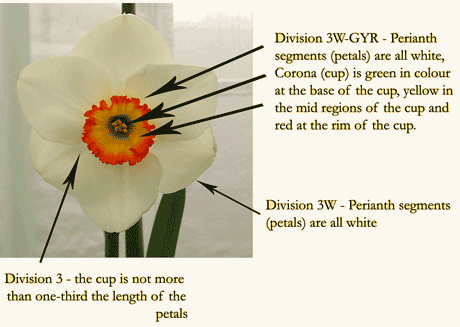
Daffodils are given a colour code to describe both the perianth (petal) colour and the cup colour. When looking at a ‘daffodil code’, the first number is the division used to categorise the daffodil. The letter or group of letters that follows the number, represents the perianth (petal) colour. The petal colour is described by beginning at the outside edge of the petal, then the middle, and lastly the inside part next to the corona. The second letter or group of letters represents the colour of the corona (trumpet or cup) starting from the eye-zone, then the mid-zone and extending out to the edge or rim.
See the photo of Kaylee Ann below as an example:
ROYAL HORTICULTURAL SOCIETY
SYSTEM OF CLASSIFICATION
All daffodils are classified into one of thirteen divisions. Each daffodil cultivar or garden hybrid belongs to one of the first twelve divisions. Those daffodils distinguished solely by botanical name belong in Division 13. Below are the definitions for each Division:
 |
Division 1
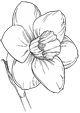
Trumpet Daffodil Cultivars One flower to a stem; corona (trumpet) as long as, or longer than, the perianth segments (petals). |
 |
Division 2
Large-cupped Daffodil Cultivars One flower to a stem; corona (cup) more than one-third but less than equal to the length of the perianth segments (petals). |
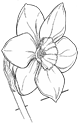 |
Division 3
Small-cupped Daffodil Cultivars One flower to a stem; corona (cup) not more Than one –third the length of the perianth Segments (petals) |
 |
Division 4
Double Daffodil Cultivars One or more flowers to a stem, with doubling of the perianth segments or the corona or both. |
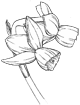 |
Division 5
Triandrus Daffodil Cultivars Characteristics of N. triandrus predominant: usually two or more pendent flowers to a stem; perianth segments reflexed. |
 |
Division 6
Cyclamineus Daffodil Cultivars Characteristics of N. cyclamineus clearly evident: one flower to a stem; perianth segments significantly reflexed; flower at an acute angle to the stem, with very short pedicel (“neck”) |
 |
Division 7
Jonquilla and Apodanthus Daffodil Cultivars Characteristics of Sections Jonquilla or Apodanthi clearly evident: one to five flowers to a stem; perianth segments spreading or reflexed flowers usually fragrant. |
 |
Division 8
Tazetta Daffodil Cultivars Characteristics of the N. tazetta group predominant: usually three to twenty flowers to a stout stem; leaves broad; Perianth segments spreading, not reflexed; flowers fragrant. |
 |
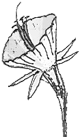
Division 9
Poeticus Daffodil Cultivars Characteristics of the N. poeticus group and related species clearly evident; Perianth segments pure white; corona very short or disc shaped, not more than one fifth the length of the perianth segments; corona usually with a green and or/yellow centre and red rim, but sometimes wholly or partly of other colours; anthers usually set at two distinct levels; flowers fragrant
|
 |
Division 10
Bulbocodium Daffodil Cultivars Characteristics of Section Bulbocodium clearly evident; usually one flower to a stem; perianth segments insignificant compared with corona; filament and style are usually curved. |
| Division 11
Split Corona Daffodil Cultivars Corona split-usually for more than half its length; Division split into a & b types, Collar & Papillon |
|
 |
a) Collar Daffodils
daffodils with the corona segments opposite the perianth segments; corona segments usually in two whorls of three. |
 |
b) Papillon Daffodils
Split-corona daffodils with the corona segments alternate to the perianth segments; the corona segments usually in a single whorl of six. |
| Division 12
Other Daffodil Cultivars Daffodil cultivars which do not fit the definition of any other division. |
|
 |
Division 13
Daffodils Distinguished Solely by Botanical Name All species and wild or reputedly wild variants and hybrids. |